 Join Us
Site Message
Only Premium Users can view the Question

Basic discussion on resume and current company's tech stack and project was common in all rounds.
Q1. Find missing smallest positive number in unsorted integer array.
{1,5,6,-2,4,2}, smallest positive number : 3
Q2. Convert linked list to complete binary tree.
Input
1->2->3->4->5->6
Output
      1
     / \
    2   3
   /\   /\
  4  5 6
Q1. Check for balanced parenthesis in a string.
Q2. Attaching Screenshot for it.
Q1. Print nth fibonacci number- both recursive and iterative.
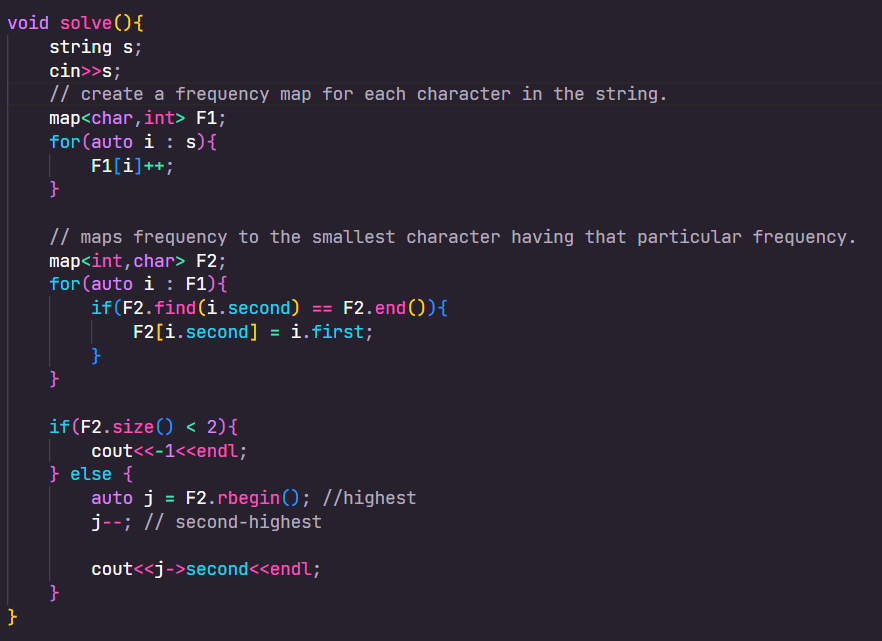
Q2. Second most repeated char in a string
Input
nkslanfaaboutcec
Output
After the 3rd round there was a basic feedback sort of a round with a different interviewer.
Interviewer also asked why you want to switch and some other basic questions.
Also asked where do you want to see yourself in 3-4 years.
Then the interviewer said that Qualcomm Hyderabad works in sync with Qualcomm Seattle (or San Diego he said I guess), so there will be another interview round of 1 hour max with the Seattle team as well either on Friday or Monday.
Interviewer asked few basic question related to resume and career like-
Next moved on to coding questions-
Q1.
Find the uncommon elements in two unsorted arrays.
Input1:
[3 4 2 3 4]
Input2:
[3 6 3 2 1 1]
Output:
[4 6 1]
I told him the brute force approach for this and moved on to the hashing based approach and coded it.
Q2.
Given a maze represented by a two dimensional arrays with R rows and C columns. Find a path from start position to exit.
You cannot move diagonally between cells.
Passable cells are marked with a period .
Impassable cells are marked with a hash #
The start position is at cell S
The exit is at cell E
For example:
###...##..
....#....#
#..###.#.#
S#.#.#.#..
...#...E#.
I applied DFS over here similar to what was used in the athletic arena problem and he was satisfied by this approach.
Overview
Approach
PseudoCode
vector <int> dp(n+1);
    dp[0]=0;
    dp[1]=1;
    for(int i=2;i<=n;i++){
        dp[i]=(dp[i-1]%mod+dp[i-2]%mod)%mod;
    }
Complexity
Note
The idea is to mark the elements in the array which are greater than N and less than 1 with 1.
The smallest positive integer is 1. First, we will check whether 1 is present in the array. If it is not present, then 1 is the answer.
If present, then, again, traverse the array. The largest possible answer is N+1, where N is the size of the array.
When traversing the array, if we find any number less than 1 or greater than N, change it to 1. This will not change anything, as the answer will always be between 1 to N+1.
Now, our array has elements from 1 to N. Now, for every ith number, increase arr[(arr[i]-1)] by N. But this will increase the value more than N. So, we will access the array by arr[(arr[i]-1)%N].
We will now find which index has a value less than N+1. Then i+1 will be our answer.
Time Complexity: O(N), N is the size of the array.
Open brackets must be closed in the correct order.
// Initialize a stack and a index idx = 0...
stack<char> stack;
int idx = 0;
// If the string is empty, return true...
if(s.size() == 0){
   return true;
}
// Create a loop to check parentheses...
while(idx < s.size()){
// If it contains the below parentheses, push the char to stack...
     if( s[idx] == '(' || s[idx] == '[' || s[idx] == '{' ){ stack.push(s[idx]); }
     // If the current char is a closing brace provided, pop the top element...
     // Stack is not empty...
     else if ( (s[idx] == ')' && !stack.empty() && stack.top() == '(') || (s[idx] == '}' && !stack.empty() && stack.top() == '{') || (s[idx] == ']' && !stack.empty() && stack.top() == '[') ){
        stack.pop();
     }
     else {
        return false;       // If The string is not a valid parenthesis...
     }
     idx++;      // Increase the index...
 } // If stack.empty(), return true...
if(stack.empty()) {
    return true;
}
return false;
Time Complexity: O(|S|)
vector<int> dx={1,-1,0,0};
vector<int> dy={0,0,1,-1};

int solve(vector<string> v)
{
    int n=v.size(),m=v[0].size();
    int sx=-1,sy=-1,ex=-1,ey=-1;
    for(int i = 0;i < n;i++)
    {
        for(int j = 0;j < m;j++)
        {
            if(v[i][j]=='S')
            {
                sx=i,sy=j;
            }
            if(v[i][j]=='E')
            {
                ex=i,ey=j;
            }
        }
    }
    queue<pair<int,int>> q;
    q.push({sx,sy});
    vector<vector<int>> vis(n,vector<int>(m,0));
    vector<vector<pair<int,int>>> par(n,vector<pair<int,int>>(m,{-1,-1}));
    vis[sx][sy]=1;

    while(!q.empty())
    {
        auto x=q.front();
        q.pop();
        for(int l = 0;l < 4;l++)
        {
            int ni=x.first+dx[l],nj=x.second+dy[l];
            if(ni < 0||ni >= n||nj < 0||nj >= m)
                continue;
            if(v[ni][nj]=='#'||vis[ni][nj]==1)
            {
                continue;
            }
            par[ni][nj]=x;
            q.push({ni,nj});
            vis[ni][nj]=1;
        }
    }
    if(par[ex][ey]!=(pair<int,int>){-1,-1}){
        vector<pair<int,int>> path;
        path.push_back({ex,ey});
        pair<int,int> curr={ex,ey};
        while(curr!=(pair<int,int>){-1,-1})
        {
            curr=par[curr.first][curr.second];
            if(curr!=(pair<int,int>){-1,-1})
                path.push_back(curr);
        }
        reverse(path.begin(),path.end());
        for(auto x:path)
            cout<<x.first<<" "<<x.second<<endl;
    }
    return par[ex][ey]!=(pair<int,int>){-1,-1};
}
Time Complexity : O(N*M)
Seattle Round Q1
Solution


